
What to do after water damage in Allen, TX
Eight moves, in the order the house asks for them, not the order panic suggests.
Emergency Line(972) 544-433924/7 emergency line. Free estimates from local pros.
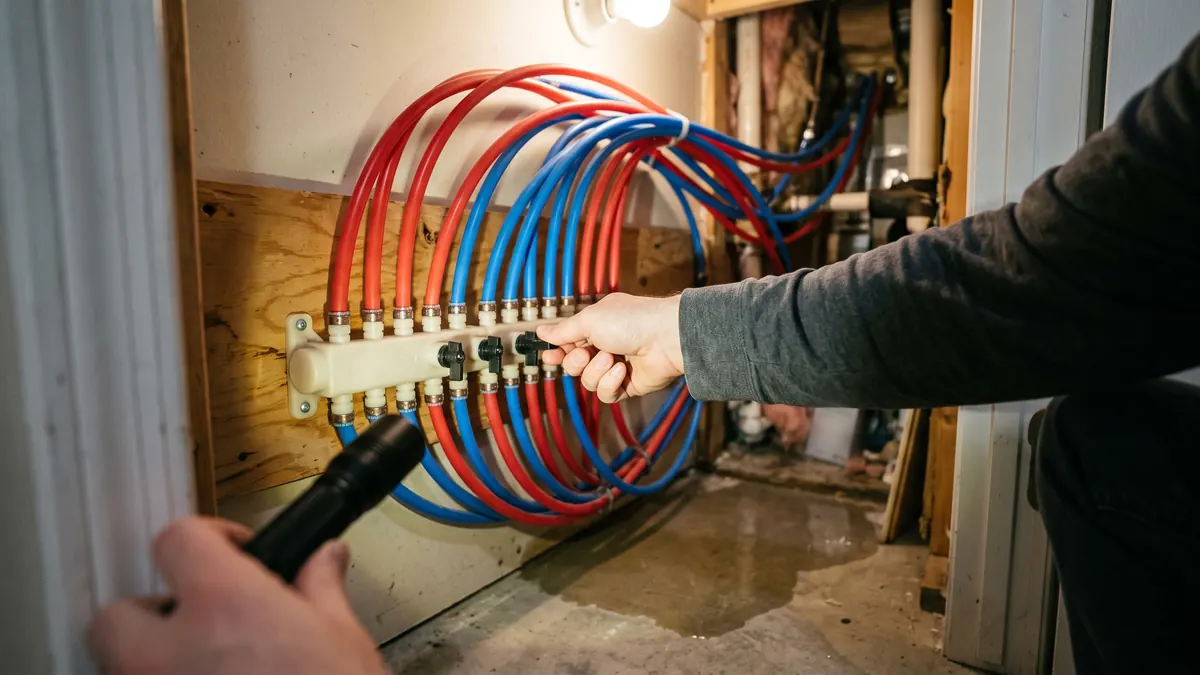
What you do first after water damage depends on where you’re standing, not a checklist copied from somewhere else. These eight moves are ordered by location instead of by importance: the valve, the breaker, the camera, the phone, the thermostat, and the front door where outside help eventually arrives.
1. At the valve, before anything else
The house’s water enters at one point, and that point has a shutoff valve. Look for it in a utility closet, along the garage wall, or near an outdoor hose bib, at whatever spot the supply line reaches the house before it branches out to every fixture. Turn it until the water stops. If you can’t find the main shutoff fast, close the valve on whichever fixture or appliance is actually leaking instead.
2. At the breaker box, if water’s close
If water has crept close to an outlet, a lamp cord, or any appliance still plugged in, don’t wait to find out whether the circuit is live. Head to the breaker panel and cut power to that part of the house first. Skip this step entirely if the panel itself sits in standing water, and call an electrician instead of guessing.
3. Phone in hand, before you touch anything
Your phone’s photo roll becomes the timeline an adjuster will ask for later, so start using it before you fix, move, or clean a thing. Get wide shots of every room the water reached, then closer shots of the source if you can see it. Note the date and time somewhere you’ll remember it; a text to yourself works fine.
4. On the call with your insurer
When you call to report the damage, expect a short set of questions: what happened, roughly when it started, and whether water is still moving. Have your policy number ready, along with the photos from step three. Ask what your insurer needs from you before the next call, and write the answer down while it’s fresh.
5. What your policy expects while you wait
Most Texas homeowner policies also expect you to slow the damage down while your claim gets reviewed. The water mitigation page sets side by side what that duty actually asks of you against what a company’s stop-loss work covers on its own.
6. At the thermostat and the windows
Turn the AC or heat down low, open windows if it’s safe to do so, and run any fan you own until every wet surface feels dry to the touch. Aim for somewhere in the 24-to-48-hour range, the point EPA guidance treats as where mold risk starts climbing.
7. At the front door, for what’s past your reach
Past a certain point, if water soaked into a wall cavity, under the flooring, or behind cabinets, that’s your cue to bring in help for the parts a box fan can’t reach. The emergency water removal page zooms in on what that first visit actually involves, and the drying time guide gives the longer version of how long the equipment side usually runs.
8. Last: the paperwork trail
Once someone’s looked at the damage, the process turns into paperwork: an estimate, a decision from your insurer, and eventually a payment, each running on its own timeline. Keep every document in one folder, physical or digital, so nothing goes missing between calls. The homeowners insurance guide charts how a policy actually reads once you’re at this stage.
The order comes from the house
This list isn’t ranked by importance. It’s ordered by where you’re standing when each step needs doing: the valve, the breaker, the phone, the thermostat, the front door. Follow the house, and the order takes care of itself.
Common questions
Is a small leak worth filing a claim over?
That depends more on the repair cost against your deductible than the size of the puddle. A leak that costs less than your deductible to fix usually isn't worth reporting, since a claim can affect future premiums. Once the damage reaches drywall, flooring, or cabinets, it's usually worth at least asking your insurer what a claim would look like.
If you rent your home, are these steps still yours to do?
The safety moves, water off, power off, photos, are worth doing no matter who owns the house. Reporting the damage to a landlord and figuring out who calls a repair company is a separate step, and most leases spell out that order. Renters insurance, if you carry it, generally covers your belongings rather than the structure itself.
Is it safe to keep living in the house while it dries?
Often yes, especially when the damage sits in one room and the power and water are both stable. Wider damage, exposed wiring, or a contaminated source usually changes that answer. When in doubt, ask whoever looks at the damage whether the affected area is fine to stay near while equipment runs.
Related pages
AC Condensate Overflow
A tripped safety switch on your AC is usually the first sign a drain line backed up somewhere behind it.
Learn more →Drying Time
Drying time isn't one number. Three questions decide it every time.
Learn more →Frozen Pipe Burst
PEX plumbing lowers the odds of a freeze burst in Allen. It doesn't erase them.
Learn more →Homeowners insurance
The answer sits in your own policy, not in a rule of thumb.
Learn more →Talk to a local pro now
We answer 24/7. One call gets a Allen crew moving on your water damage, with a free estimate and help with your insurance claim.
Emergency Line(972) 544-4339Free estimates. No obligation to hire.